Emoji, Reactions and the New Grammar
How a thumbs-up became a full sentence — the tiny language we all now speak.
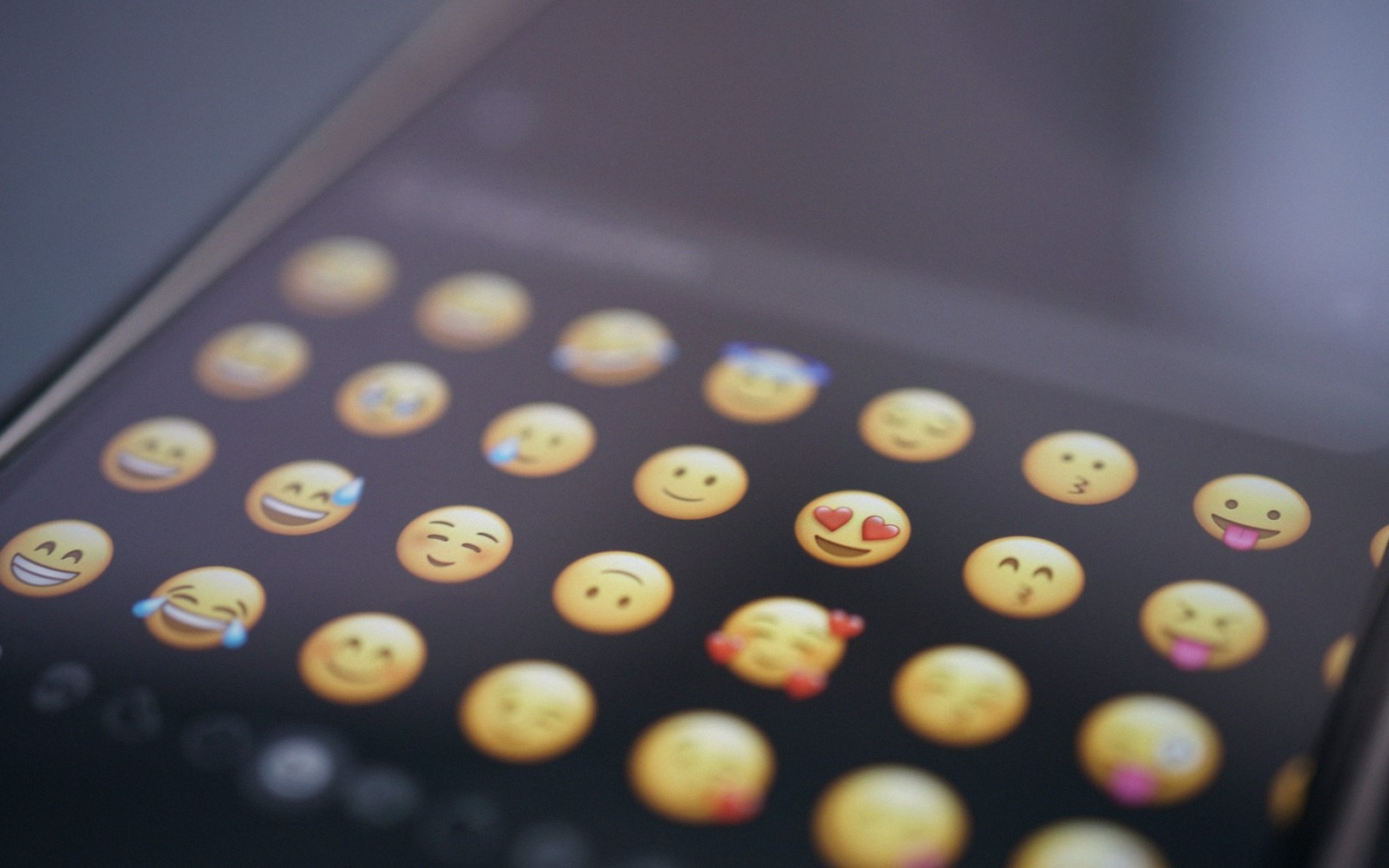
01 The Word We Replaced with a Yellow Circle
There's a moment in every chat thread when someone sends a message that doesn't quite warrant a reply but absolutely deserves acknowledgment. Ten years ago, you'd type "haha" or "nice" and feel faintly absurd. Now you press a heart, a thumbs-up, or — if you're feeling precise — a 🫡, and the conversation moves on. Everyone understood. Nothing was lost. That is genuinely new.
Emoji didn't arrive with messaging apps. The first standardized set came from Japan in the late 1990s, built into NTT DoCoMo's i-mode service — 176 tiny fixed-pixel images designed to reduce ambiguity in short mobile messages. When Unicode formally absorbed emoji in 2010, the door opened to a shared visual vocabulary across every platform, and the roster ballooned from hundreds to thousands. What changed in the 2010s wasn't the pictures themselves but the grammar built around them.
02 Reactions: The Minimum Viable Response
The reaction — tapping a message to stamp it with a single emoji — is a different beast from typing an emoji into the text field. Reactions arrived on Facebook in 2016 as an expansion of the Like button: six options, each mapping roughly to an emotional register (love, haha, wow, sad, angry). The logic was additive; you could show something more granular than a thumbs-up without fragmenting the thread with noise. It worked so well that iMessage, WhatsApp, Telegram, Slack, and Signal all followed with their own versions, each with slightly different rules about which emoji are permitted.
The restriction is the feature. A reaction is a vote, not a message. It collapses into a tiny counter beneath the original text, invisible to anyone skimming quickly, visible the moment you care. This asymmetry — low effort to send, low intrusion to receive — made the reaction the de-facto full stop of digital conversation. The thumbs-up on a work Slack message no longer means I enthusiastically endorse this. It means received, noted, moving on. Context collapsed the meaning; frequency normalized the new one.
Context collapsed the meaning; frequency normalized the new one.
03 A Grammar, Not Just Decoration
Linguists talk about paralanguage — the tonal and gestural signals that carry meaning alongside words. Emoji slotted into that gap in text. A dry sentence followed by 😐 lands differently from the same sentence followed by 😅. Neither changes the words; both change everything. What's happened more recently is subtler: emoji and reactions have developed positional grammar of their own. Trailing emoji soften or amplify. A single emoji sent as an entire message is tonal, not informational. A string of three often signals irony or overwhelm.
Generational splits are real here. For many younger users, a plain-text "okay" without any softening punctuation or emoji reads as cold, even hostile. The period at the end of a sentence has acquired a separate, slightly ominous weight in casual chat — precision mistaken for aggression. The emoji absorbed the warmth that punctuation used to signal, and now its absence is felt.
04 What Gets Lost
None of this is frictionless. Emoji render differently across platforms — the same Unicode codepoint can look gentle on one OS and aggressive on another, a gap that has caused real misreadings. Reactions carry no context: a 😂 on a message about a difficult day can wound. And the compression of feeling into a single tap has a cost: the short, considered reply that took thirty seconds to compose now feels effortful in a way it didn't before.
Still, the thumbs-up endures. It is, at this point, less an emoji than a punctuation mark — and punctuation, once it settles, tends to stay.
◆ A short timeline
- Late 1990sNTT DoCoMo introduces first standardized emoji set on i-mode
- 2010Unicode absorbs emoji; cross-platform vocabulary becomes possible
- 2016Facebook expands Like to six Reactions; the model spreads to messaging apps